

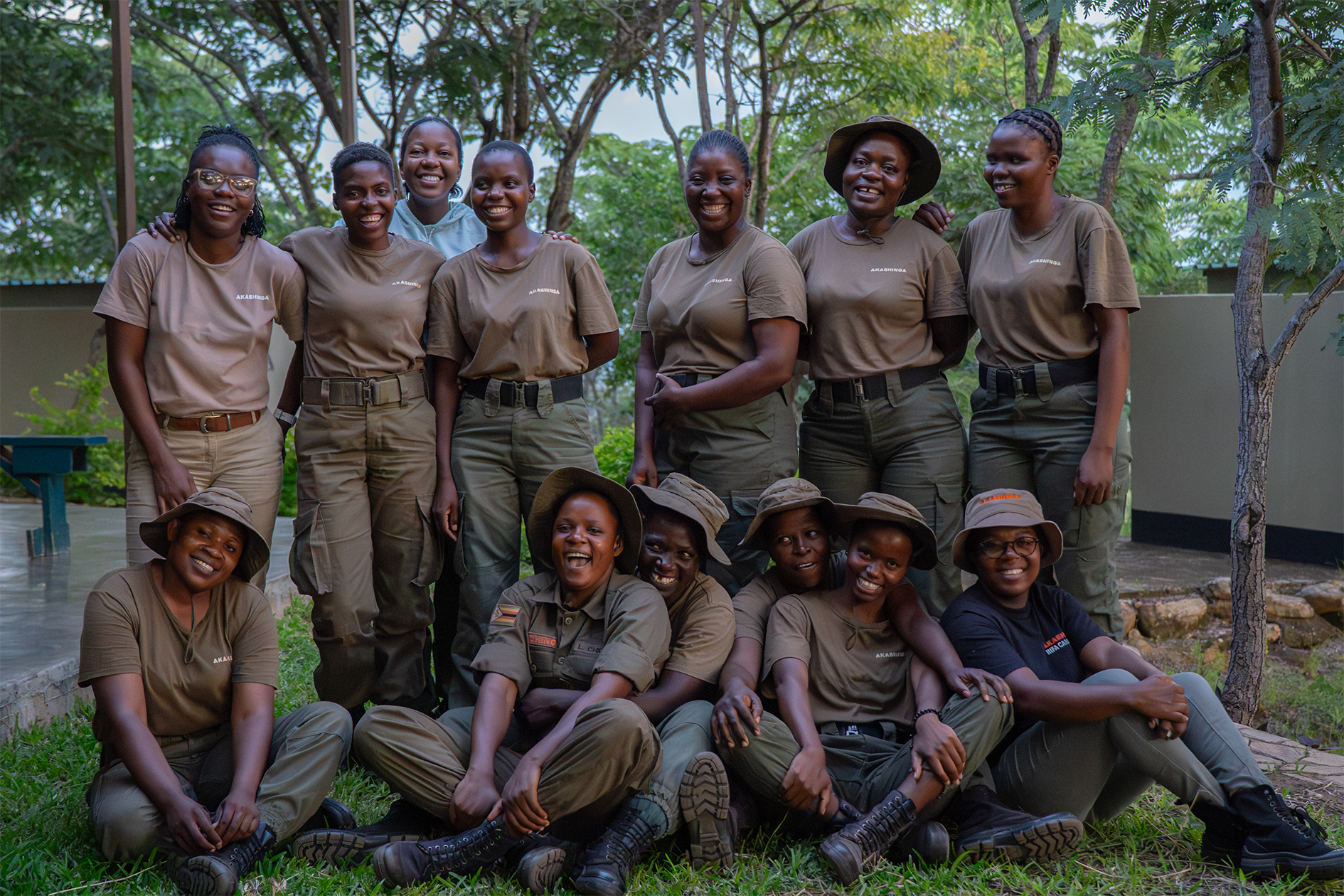
The Akashinga Ranger Report is a quarterly newsletter that puts you behind-the-scenes with Africa’s plant-based, all-female Akashinga Rangers. You'll be immersed in the rangers’ activities, experiences, stories, and achievements as they protect, connect, and restore invaluable ecosystems across Southern and East Africa.
Support ranger-led conservation that is built to endure. Give monthly, or make a one-time contribution to sustain the teams, systems, and landscapes behind this work.
New Training Partnership Builds Skills Across Songo and Phundundu
.png)
(Photo: Glenda Beselemu)
The heat in Akashinga’s Songo Reserve settles heavily over the open field. Knee‑length grass brushes against the legs of rangers in formation, ammunition in hand, eyes fixed on Eve Mudenda as she delivers a firearms training. Each command is met with discipline: firearms raised, stances adjusted in unison. In demanding conditions, strength is forged and skills are sharpened.
Since September 2025, Akashinga staff in Songo have completed three training courses in collaboration with Mellivora , an organisation specialising in ranger development programmes. Delivered over six weeks across Songo and Phundundu Reserves in Zimbabwe, the sessions covered Park Planning and Management, Patrol Leadership and Operations, and Firearms Training, building on the Akashinga Rangers’ existing skills and broadening their operational knowledge.
For those rangers in leadership roles, the impact has been significant. Talent Dube, Deputy Head of Operations at Songo, says the trainings have sharpened her ability to lead and plan effectively, deepening her confidence in delivering lessons to other rangers, managing operations, and making sound decisions during patrol.
“I gained experience and confidence in how to plan all the activities and operations within our conservancy,” she says. “I also gained additional skills in clear report writing and engaging with other departments."
.png)
Songo Operations Room Controller Belinda Mukomberanwa found the Firearms Training particularly valuable, gaining exposure to the Ranger Rifle, a different model from the one the team typically uses. "These trainings have strengthened my confidence as a leader and improved how I make decisions in different situations,” she says.
For Training Programme Manager Pamela Maisiri, the value of the Mellivora partnership lies in its breadth and diversity. While their previous training was largely localised, this programme has introduced Akashinga Rangers to new methods and wider operational environments.
“It widens the scope of knowledge of rangers, and they are able to apply it on a daily basis in support of what they had already learned,” she says.
Back on the training ground, the heat hasn't lifted. But the rangers in formation move with something new: not just the discipline they arrived with, but a broader set of tools to draw on when it matters most.
Inside Akashinga's First Comprehensive Vegetation Survey
.png)
Akashinga’s Biodiversity team is conducting its first comprehensive vegetation survey, a critical step in understanding ecosystem health across the Phundundu landscape in Zimbabwe's Lower Zambezi Valley.
“You cannot monitor what you don’t know,” explains Biodiversity Officer Nyaradzo Hoto. By identifying plant species across the area, the team is building a foundation for long-term monitoring, research, and enhanced conservation planning.
The survey is a collective effort across departments. Rangers support fieldwork and rotate participation to during surveys, while the Habitat Department contributes through the tree nursery. The Maintenance Department constructed a 1m² quadrat, an essential tool used to sample vegetation. Rangers also ensure the safety of the team by monitoring the area for wildlife during data collection.
The survey is carried out along 50-metre transects, with a one-metre buffer on either side. Within this area, the team records trees, grasses, flowers, and forbs.
.png)
To sample ground vegetation, five 1m² quadrats are placed along each transect. A compass is used to establish accurate alignment, and data is collected on plant density and condition.
“The grass sampling helps inform fire management planning,” says Nyaradzo. “It determines when and how controlled burns should take place.”
Tree data is collected through physical counts, and a range finder is used to measure height. Field guides support species identification, alongside the use of scientific naming.
This work highlights the role of vegetation in supporting wildlife and maintaining ecosystem balance. The data collected will inform future research, support patrol planning, and strengthen monitoring of conservation areas.
Ranger Profile: Future Sibanda
.png)
Future Sibanda grew up in Mutorashanga, a small town in Zimbabwe’s Mashonaland West province. She had always believed in looking after the environment, and in 2017 that belief brought her to the first Akashinga selection course. The training was demanding, but she persevered through every challenge and graduated among the sixteen women who completed the programme.
Her family had reservations. Ranger work, in their experience, was a profession for men. The stories she had heard about human–wildlife conflict were intimidating. But Future’s determination to protect her environment was stronger. Today, now residing in Magunje near Karoi, her days often begin at 5am.
.png)
“This work demands focus and courage. It is not easy. We encounter different animals in the forest, and at times you might cross paths with lions,” she says. “But because of my commitment to this job, and because I love being a ranger, it is enjoyable. I continue to work hard, and I enjoy teaching my children about the wildlife I come across on patrol.”
Over the years, the work has become a source of both strength and independence.
“This job has really uplifted me and given me independence. I am living proof that rangers are not just men. Some women can do this work, just like me.”
.png)
Future is proud that one of her children has shown interest in becoming a ranger. Her work in conservation has shaped how her family understands and values wildlife, a legacy she did not anticipate when she first signed up. She also has plans beyond the field: with the income her work provides, she hopes to start a small business, beginning with a solar-powered fridge.
For Future, the two ambitions are not in tension. She intends to keep serving as an Akashinga Ranger for as long as she is able, growing alongside the landscapes she helps protect.
Spotlight Story: World Wildlife Day
.png)
On the 3 March 2026, Akashinga joined national partners in commemorating World Wildlife Day at an event hosted by Zimbabwe Parks and Wildlife Management Authority (ZimParks) at the ZimParks Gardens in Harare. Africa Environment Day (Wangari Maathai Day) was also observed during the gathering.
The event brought together a range of conservation stakeholders, including the Forestry Commission, World Wide Fund for Nature (WWF), and the Environmental Management Agency. These gatherings provide an important opportunity for collaboration, knowledge exchange, and strengthening partnerships across Zimbabwe’s conservation sector.
Akashinga Rangers and staff participated alongside these partners, reinforcing relationships that support coordinated conservation efforts across the country.
This year’s theme, “Medicinal and Aromatic Plants: Conserving Health, Heritage and Livelihoods,” highlighted an important dimension of conservation: protecting plant life and ecosystems that sustain wildlife, communities, and cultural traditions.
The theme also reflects work currently being carried out by Akashinga’s Biodiversity team, which conducts vegetation surveys to better understand plant diversity and ecosystem health across the landscapes we protect.
.png)
While Akashinga is widely known for wildlife protection and counter-poaching operations, our work extends across the broader landscape. By monitoring logging activity, protecting habitats, and supporting ecosystem health, Akashinga teams contribute to the protection of vegetation and the ecological systems that sustain biodiversity.
Participation in events such as World Wildlife Day helps strengthen our the shared commitment to protecting the country’s natural heritage.
Spotlight Story: International Women’s Day
.png)
On 8 March, Akashinga joined the global community in commemorating International Women’s Day under the theme “Rights. Justice. Action. For ALL Women and Girls.” The theme calls for meaningful progress toward equality by recognising rights, pursuing justice, and taking action.
For Akashinga, this message resonates deeply. Akashinga Rangers are women who have stepped into a profession historically reserved for men, demonstrating every day that courage, discipline, and leadership are not defined by gender.
Behind the uniform, these rangers are also mothers, wives, daughters, and sisters. They carry the strength of their communities into their work, balancing responsibilities at home with demanding roles in the field.
Through their work, Akashinga Rangers challenge outdated assumptions about what women can and cannot do. They protect wildlife, safeguard ecosystems, and contribute to the wellbeing of the communities where they live and work.
International Women’s Day offers an opportunity to recognise their commitment and professionalism, and it serves as a reminder that celebration must be matched with action. Their work shows that when women have access to opportunity, entire communities and ecosystems benefit.


